 By
By Full financial independence is a long way off for most people. Twenty years of saving is a normal estimate, and that is if nothing goes wrong. Barista FIRE is the question that makes that wait shorter: what if you didn’t have to stop working completely, only stop working as much as you do today?
Barista FIRE is the point where your investments can cover the part of your spending that a relaxed part-time job doesn’t. The job pays some of your bills and your portfolio pays the rest, for good. You haven’t retired. You have stopped needing the full-time career.
In this post I go through what Barista FIRE is, how to work out your own number, a worked example with real figures, how it differs from Coast FIRE, and how I track it in Lume, a private, offline-first FIRE tracker for Mac and iPhone. It is one of the types of FIRE, and the one I think most people should be aiming for first.
What Barista FIRE means
The name comes from the idea of leaving a demanding job for a few shifts a week at a coffee shop, originally for the health insurance that came with the job in the US. The coffee is incidental. The part-time work could be a few days of freelancing, a job at the bike shop, teaching, seasonal work, or your current job at three days a week. What matters is that:
- it brings in a steady, modest income
- you would do it without resenting it
- it doesn’t cover all your spending, so your investments pay the gap.
That last point is what separates Barista FIRE from simply taking a lower-paid job. At Barista FIRE you start drawing on your portfolio. You are living partly on your investments now, not saving into them.
How to work out your Barista FIRE number
The number comes from two figures you already know, or can find out:
- What you spend a month. All of it: rent or mortgage, food, bills, insurance, the holiday, the annual car service divided by twelve.
- What the part-time work would bring in a month, after tax.
Your portfolio has to cover the difference, for as long as you live off it. Under the 4% rule, a portfolio can pay out about 4% of its value a year, rising with inflation, and last at least thirty years. So:
Barista FIRE number = (monthly spending − part-time income) × 12 ÷ 4%
Dividing by 4% is the same as multiplying by 25, which is the shortcut you’ll see in most FIRE writing.
The 4% figure comes from William Bengen’s 1994 study of historical US returns, and was tested again in the 1998 “Trinity study” by Cooley, Hubbard and Walz. It is a rule of thumb, not a guarantee, but it is the one most FIRE planning starts from, and is what I’ll use throughout this post.
A worked example
Say you are 35. You take home €3,500 a month and spend €2,240 of it, so you save €1,260, a savings rate of 36%. You have €80,000 invested, and it grows 5% a year after inflation.
Full FIRE is your whole spending under the 4% rule: €2,240 × 12 ÷ 4% = €672,000. At your current savings rate you reach it at about 54.
Now say a part-time job would bring in €1,200 a month after tax. Your portfolio only has to cover the other €1,040:
€1,040 × 12 ÷ 4% = €312,000
Less than half the full number. At the same savings rate you reach it at about 44 or 45: nearly ten years before full FIRE.
The part-time income is the lever, and it moves the date a long way:
| Part-time income a month | Barista FIRE number | Reached at about |
|---|---|---|
| €0 (full FIRE) | €672,000 | 54 |
| €600 | €492,000 | 50 |
| €900 | €402,000 | 47 |
| €1,200 | €312,000 | 45 |
| €1,500 | €222,000 | 41 |
| €1,800 | €132,000 | 38 |
Starting at 35 with €80,000 invested, saving €1,260 a month, 5% real return, 4% withdrawal rate.
Two things stand out in that table.
Every €100 a month of part-time income removes €30,000 from the target. A job that pays a little better, or a couple of hours more a week, is worth years.
If the part-time income covers all of your spending, you are there already. At that point it isn’t Barista FIRE any more, it’s just a job you like, and everything you invest is a bonus.
Getting the inputs right
The formula is simple. The places people fool themselves are in the inputs.
Use after-tax income. A part-time salary of €1,500 gross is not €1,500 in your account. Use what would actually land there, after tax and social contributions.
Price what the full-time job was paying for. In the US this is health insurance, which is where the barista idea started. In most of Europe healthcare doesn’t depend on your job, but other things do: pension contributions, a company car, a phone, a gym membership. If the job paid for it and you’ll keep it, it goes into your spending.
Be honest about how long the part-time work lasts. The formula assumes the part-time income keeps coming for as long as you draw on the portfolio. For most people it doesn’t have to be forever: a state pension, or reaching full FIRE by growth alone, eventually takes over from it. But if the job ended at 50 you would need to know what happens then. Pick an income you could realistically keep up, not the best month you’ve ever had freelancing.
Keep your spending figure real. This is the one input that changes the most, and the one most people estimate instead of measure. A number from your actual statements beats a budget you intend to keep.
Barista FIRE vs Coast FIRE
Barista FIRE and Coast FIRE sound alike: both involve still working, and both come well before full FIRE. They are opposites in the one way that matters.
With Barista FIRE, you draw on your portfolio now. Work pays part of your spending and your investments pay the rest, starting today.
With Coast FIRE, you don’t touch your portfolio at all. Work still pays all of your spending. You just stop adding to your investments, and let compounding carry them to your full FIRE number by the age you want to stop.
The number comes from a different formula too. Coast FIRE is your full FIRE number discounted back to today by the years you have left:
Coast FIRE number = FIRE number ÷ (1 + return)^years to go
With the same spending, a €672,000 FIRE number, 20 years to go and a 5% return, that is €672,000 ÷ 1.05^20, about €253,000.
| Barista FIRE | Coast FIRE | |
|---|---|---|
| Whay pays today’s spending | Part-time work and your portfolio | Work, all of it |
| What your portfolio does | Pays out, around 4% a year | Grows untouched |
| Keep saving? | No | No |
| The number depends on | Your spending and your part-time income | Your FIRE number, your return and the years left |
| Main risk | The part-time income stops | Returns fall short of the assumption |
Which one suits you depends on what you want to change. If you want to work less, Barista FIRE is the goal: it is the one that lets you cut your hours. If you’re happy working, and want to stop worrying about saving or take a lower-paid job you’d prefer, Coast FIRE gets you there, often with a smaller number. The two aren’t exclusive: a lot of people who reach Coast FIRE later decide to go part-time, and at that point they are working out a Barista number.
Lume doesn’t show a Coast FIRE date yet. It comes with Lume 3.0, worked out by the same scenario engine as the app’s other dates rather than by the single formula above.
Tracking your way to Barista FIRE in Lume
A Barista number worked out once on the back of an envelope goes out of date the month your spending changes. The point of tracking it is to watch the number and your progress towards it move together, from real data. This is how I do it.
Your spending comes from your statements
Each month I close the month in Lume: I import my bank’s statements, and Lume works out what I actually spent and what I now own. That spending is what the Barista target is built from, so the target follows the life I’m living rather than the one I planned in a spreadsheet two years ago. (How the close works is in The Monthly Close.)
Set the part-time income

In Settings, Barista FIRE is set by the part-time income: a monthly amount, after tax. Lume takes it off your spending and works the target through at your withdrawal rate, so Settings shows you the number the formula above gives. Until you enter one, Lume assumes the part-time work covers half your spending.
Watch the milestone, with a date and an age
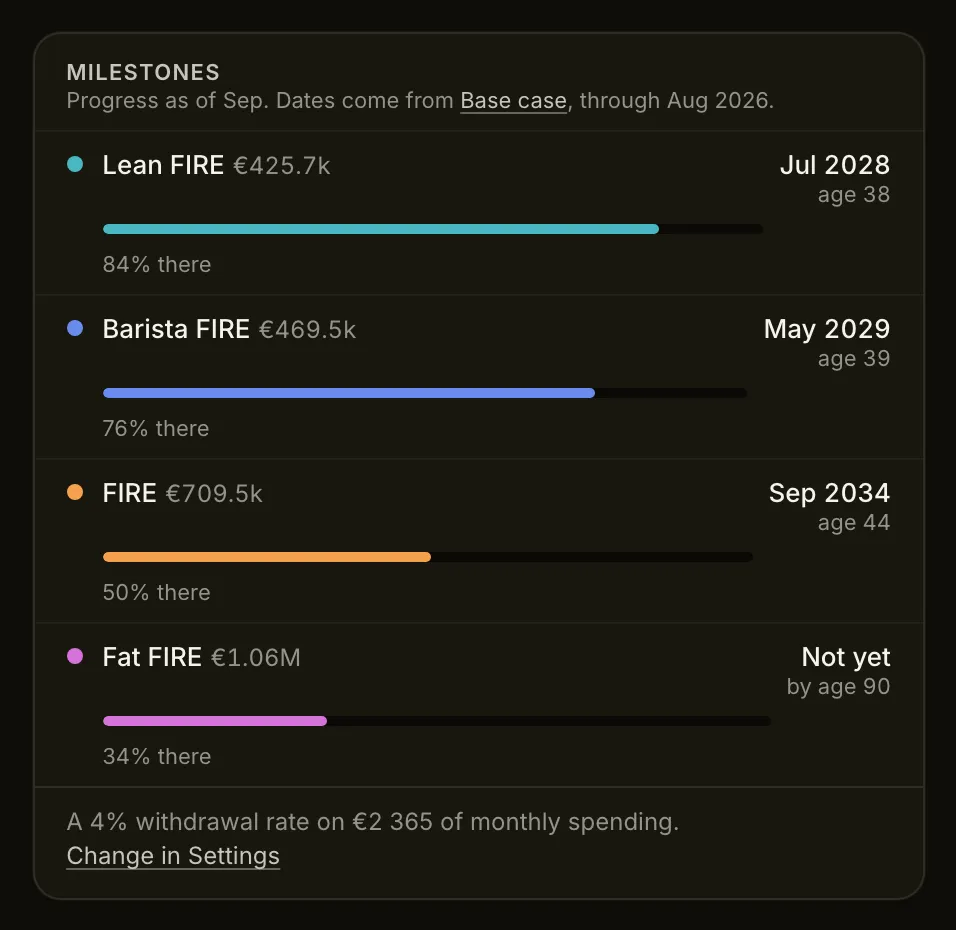
On the dashboard, Barista FIRE sits between Lean FIRE and FIRE, next to your net worth, and fills as your net worth grows. With a scenario set up, it also carries the month and the age you could reach it, and both move with every close. A month where you save more than usual brings the date forward. A month where spending creeps up pushes the target out.
Try a different job in a scenario

Each scenario can take a different part-time income, so the table above stops being hypothetical: I can ask what three days a week at my current job does to the date, against two days of freelancing, and see both side by side. The scenario form shows the sum it is doing, (spending − part-time income) × 12 ÷ withdrawal rate, so you can check it against your own maths.
Where to go from here
Barista FIRE is the milestone where work becomes something you choose the amount of. For a lot of people it is a goal worth aiming at, not a stop on the way to something else, and it arrives years before the number most FIRE writing starts with.
To work out yours, you need two honest figures: what you really spend, and what part-time work you’d really do. The rest is one line of maths. If you want to see the other milestones next to it, Types of FIRE covers Lean, Coast, FIRE and Fat, and Getting Started shows how to set your targets in Lume.
This post is general information, not financial advice. The 4% rule is based on historical returns, which aren’t a promise about future ones.
General information, not financial advice. Your taxes, pension and circumstances will differ from the examples here. More on that.